
Stoneleigh Brokerage Report | May 2026
Each month, we analyze GTA industrial fundamentals to provide decision-ready insight. Our focus is simple: translate market data into strategy

GTA Industrial Leasing Snapshot – May 2026
Toronto’s retail market continued to show encouraging momentum heading into the spring leasing season. In February 2026, retail sales in the Toronto CMA increased 1.3%, outperforming both Ontario (+1.0%) and Canada (+0.7%).
This points to continued consumer activity across the region and provides a supportive backdrop for neighborhood plazas, service-oriented retail, food uses, and grocery-anchored centers.
This growth points to continued consumer activity across the region, supporting demand for well-located retail plazas, service-based businesses, food uses, grocery-anchored centers, and convenience-oriented tenants.
While one month of data does not define the entire leasing market, the latest results suggest that day-to-day spending activity remains healthy in Toronto relative to broader provincial and national trends. This is particularly relevant for landlords and tenants operating in local retail formats where demand is often tied to convenience, visibility, repeat traffic, and essential consumer spending.
Small-bay and neighborhood retail assets continue to benefit from practical, needs-based demand. Uses such as food service, grocery-related retail, personal services, wellness, and general convenience retail remain important contributors to leasing momentum in many GTA submarkets. For owners, this reinforces the value of maintaining well-positioned, well-managed retail environments that can attract and retain stable occupiers.
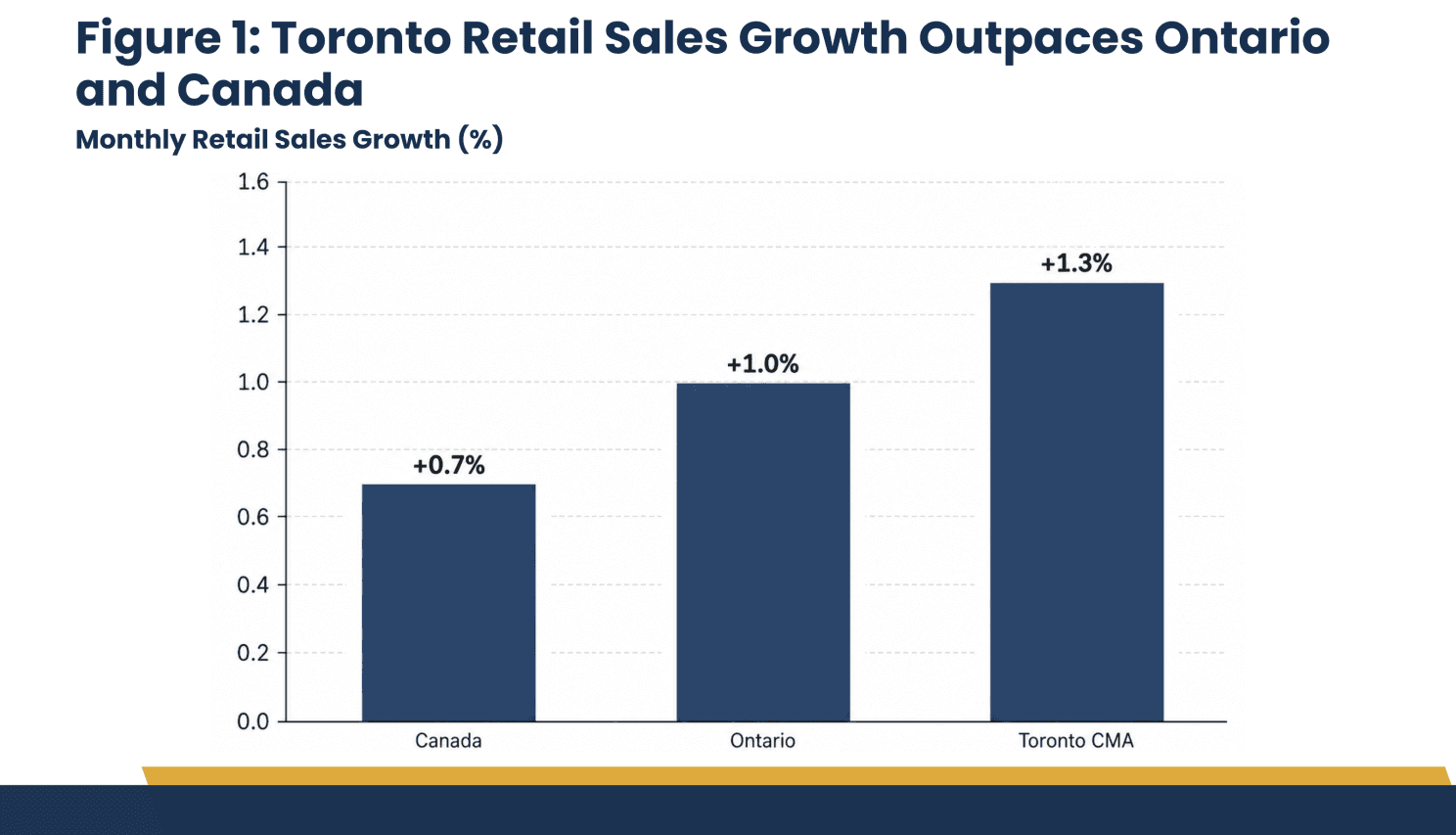
Statistics Canada, Retail Trade, February 2026. Seasonally adjusted monthly change by geography.
Toronto’s 1.3% retail sales increase in February put the CMA 0.3 percentage points ahead of Ontario and 0.6 percentage points above the national average, reinforcing that the Toronto market continues to outperform broader retail trends. Ontario also recorded the largest provincial increase in dollar terms, led in part by stronger sales at motor vehicle and parts dealers, while Toronto’s performance highlights the relative strength of the region’s consumer base.
Beyond the headline growth rate, broader retail indicators also remained constructive. Core retail sales rose 0.6% in February, marking a second consecutive monthly increase. In volume terms, retail sales were up 0.3%, showing that growth was not purely nominal. Statistics Canada’s advance estimate also suggests overall retail sales increased a further 0.6% in March, pointing to continued momentum heading into the spring market.
Retail sales volume growth
Canada retail sales: +0.7% in February 2026
Ontario retail sales: +1.0% in February 2026
Toronto CMA retail sales: +1.3% in February 2026
Core retail sales: +0.6%
Retail sales volume growth: +0.3%
Food and beverage retailers: +0.9%
Supermarkets and other grocery retailers: +1.6%
General merchandise retailers: +1.2%
Advance estimate for March retail sales: +0.6%
Retail e-commerce sales: $5.1 billion, representing 7.0% of total retail trade
These figures support the view that consumer demand remains active in categories that matter most to local plaza performance. Grocery and food-related spending trends are particularly relevant for neighbourhood retail assets, where daily-needs traffic often supports surrounding tenants and helps maintain leasing resilience
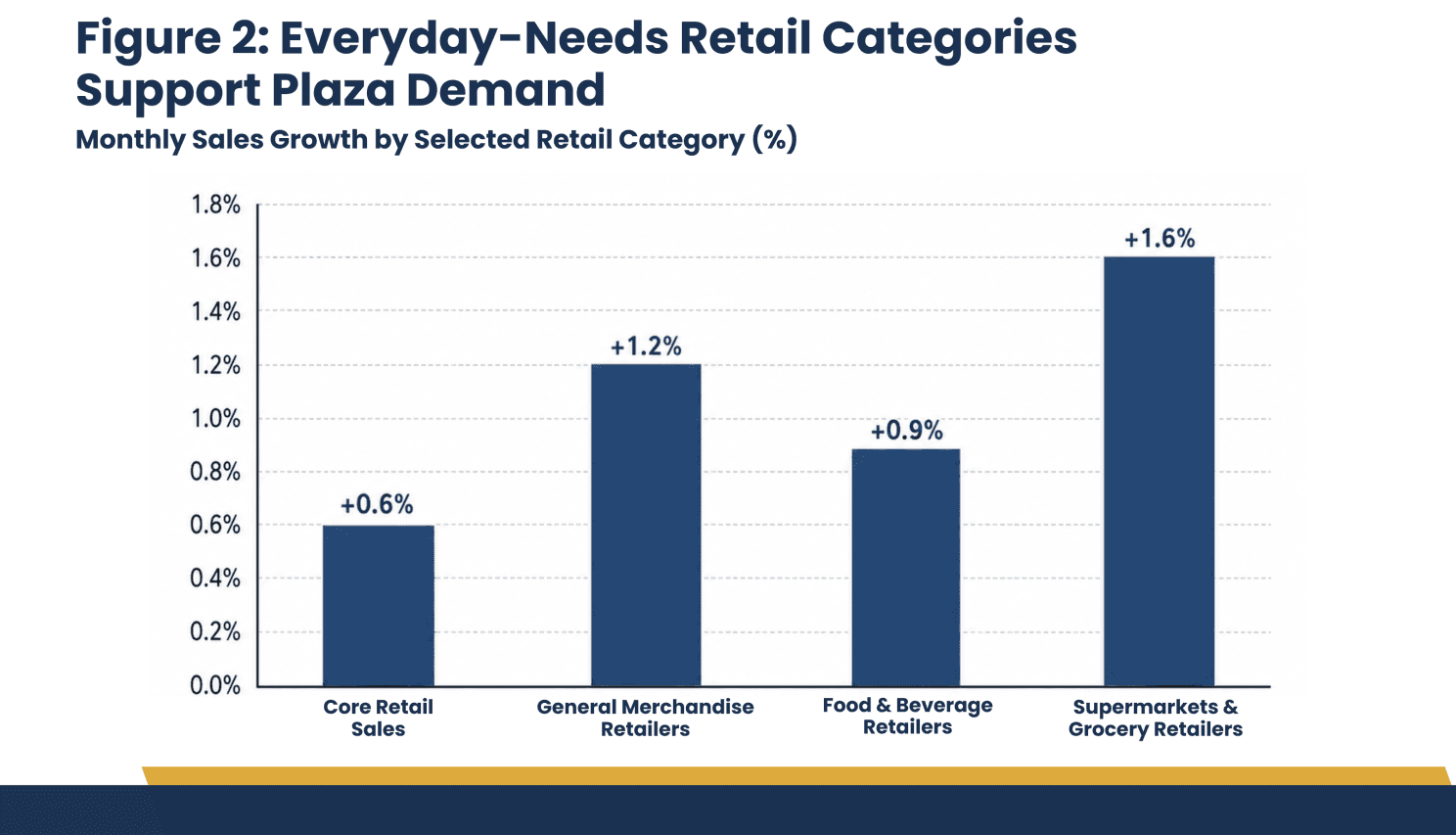
Statistics Canada, Retail Trade, February 2026. Seasonally adjusted monthly sales growth by selected retail category.
A closer look at category-level performance helps explain why many convenience-oriented retail formats remain relatively stable. In February, general merchandise retailers rose 1.2%, food and beverage retailers increased 0.9%, and supermarkets and other grocery retailers climbed 1.6%. These gains contributed to the overall 0.6% increase in core retail sales, underscoring the continued strength of everyday-needs spending categories.
For neighbourhood plazas and community retail centres, these are meaningful indicators. Stronger grocery, food, and essential retail activity can support tenant performance, reinforce traffic patterns, and improve leasing confidence in well-located assets. While not every retail category is moving at the same pace, the data suggests that practical, necessity-driven retail continues to provide an important foundation for the market.
Why this matters
The current environment presents a more balanced retail market overall, with continued support from consumer spending and category-level growth in essential retail segments. For landlords, this reinforces the importance of strong tenant mix, visible signage, accessible parking, curb appeal, and responsive day-to-day property management. These fundamentals play a direct role in supporting customer traffic and long-term occupancy.
For tenants, the data suggests continued opportunity in neighbourhood retail spaces, particularly for businesses serving daily needs, local customers, and established communities. Well-positioned plazas with consistent traffic patterns and service-oriented co-tenancy remain attractive options for occupiers looking to establish or expand their presence.
For owners and investors, the broader takeaway is that the Toronto retail market continues to show relative resilience. While leasing conditions remain selective and location still matters, the underlying consumer backdrop remains constructive for well-located retail assets. Strategy, timing, and product fit are increasingly important in a market where performance is closely tied to convenience, accessibility, and tenant quality.

Check it out here:

Check out our Socials Below:





Explore two industrial/warehouse units available in Oshawa, offering flexible space and convenient access within Durham Region.

Freestanding 47,337 SF industrial warehouse in Whitby’s established employment corridor, offering full-building functionality and efficient shipping access. Exceptional proximity to Highway 401 provides seamless connectivity across the GTA East and Durham Region.

Industrial development land at Burns St. E, Whitby. A rare opportunity within an established employment node, offering flexible use potential and strong positioning for future development. Minutes to Highway 401, delivering seamless access across Durham Region and the GTA East.

GTA Industrial Market Stabilizes as Small-Bay Demand Leads Leasing

Each month, we analyze GTA industrial fundamentals to provide decision-ready insight. Our focus is simple: translate market data into strategy

Each month, we analyze GTA industrial fundamentals to provide decision-ready insight. Our focus is simple: translate market data into strategy